Knowledge Map
Extracted knowledge organized by domain. Every entry traces back to one or more sources with quotes, context, and links. See meta/taxonomy.md for classification rules.
Entry types: technique · mental-model · insight
Entry status: draft → solid (multiple sources) → canonical (vetted, teachable)
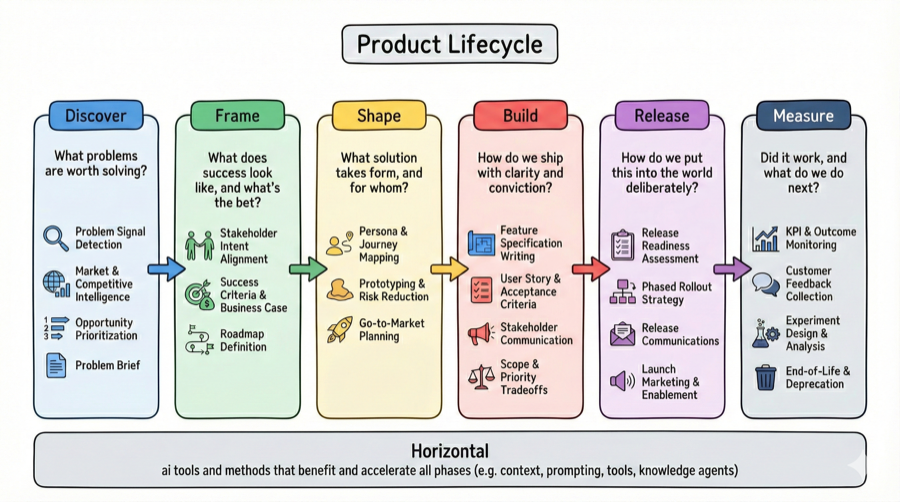
Product Lifecycle
Six phases. Entries sit flat within phase folders; the component frontmatter field records the most specific applicable component. See meta/lifecycle-framework-v2.md for full phase lineage and AI-PM emphasis.
Discover
What problems are worth solving? Components: Problem Signal Detection · Market & Competitive Intelligence · Opportunity Prioritization · Problem Brief
- Quote Selection Rules for AI Analysis — Define explicit quote rules before AI extraction to prevent generation of plausible-sounding paraphrases
discover/problem-signal-detection - Quote Verification Pass — Dedicated follow-up prompt to confirm each extracted quote exists verbatim in the source
discover/problem-signal-detection - Decision-Anchored Analysis Context — 4-component context loading (project context, business goal, product context, participant overview) to anchor AI analysis to your specific decision
discover/problem-signal-detection - Few-Shot Calibration for Analysis Classification — Labeled examples with rationale for each category level; examples teach, descriptions don’t
discover/problem-signal-detection - AI Analysis Multi-Pass Verification — Deliberate second pass targeting quote errors, within-participant contradictions, and thin evidence
discover/problem-signal-detection - Latent Demand as Product Signal — Find what people are already doing despite friction; observed off-label behavior reveals unmet demand before any ideation effort
discover/problem-signal-detection
Frame
What does success look like, and what’s the bet? Components: Stakeholder Intent Alignment · Success Criteria & Business Case · Roadmap Definition
No entries yet.
Shape
What solution takes form, and for whom? Components: Persona & Journey Mapping · Prototyping & Risk Reduction · Go-to-Market Planning
- Shape the Product — AI Disruption Profile — Determining what to build; most disrupted PM job (🤖🤖🤖), especially strategy/vision (🤖🤖🤖🤖)
- Parallel Prototyping for Clarity — Start 5 parallel builds with increasing specificity; AI makes prototyping cheap enough to explore broadly before converging
Build
How do we ship with clarity and conviction? Components: Feature Specification Writing · User Story & Acceptance Criteria · Stakeholder Communication · Scope & Priority Tradeoffs
- Interactive PRD Writing — Templatized rule files + AI follow-up questions for thorough PRDs
build/feature-specification-writing - Task List Generation for Observability — Decomposing PRDs into nested task lists for observability and control
build/user-story-acceptance-criteria - Context First Development — The biggest mistake in AI-assisted dev is rushing past context
build - Ship the Product — AI Disruption Profile — Helping the team deliver; moderately disrupted (🤖🤖), scope tradeoffs remain human-driven
Release
How do we put this into the world deliberately? Components: Release Readiness Assessment · Phased Rollout Strategy · Release Communications · Launch Marketing & Enablement
No entries yet.
Measure
Did it work, and what do we do next? Components: KPI & Outcome Monitoring · Customer Feedback Collection · Experiment Design & Analysis · End-of-Life & Deprecation
No entries yet.
Horizontal Domains
Lifecycle-agnostic AI PM skills and knowledge areas, organized by delivery mechanism with increasing capability and autonomy. See taxonomy for classification rules.
Prompting — Portable Techniques
Portable techniques for crafting effective instructions — works in any chat window. Prompting patterns, meta-skill patterns, writing workflows, role delineation.
- Be 100x More Specific — Forces AI past vague principles into concrete, actionable standards
- My Job Your Job Role Delineation — Explicit human/AI responsibility partitioning
- AI as Writing Coach — Structured workflow: thesis validation → blind spots → restructuring
- LLMs Generate, Not Retrieve — Root cause mental model: LLMs produce statistically plausible text, not retrieved text; explains hallucinated quotes, fabricated citations, confident errors
Context & Knowledge Management — Knowledge Infrastructure
Making non-code knowledge discoverable and usable to agents and their human coworkers — context graphs, agent-oriented knowledge management, progressive disclosure.
- Deliberate Context Selection — Hand-picking files for LLM context vs. relying on automatic context
- Sync the People — AI Disruption Profile — Human coordination and alignment; least disrupted PM job (🤖), a durable competitive advantage
- Three-Layer Context Disclosure — Index → summary → full content: the converging pattern for efficient agent retrieval (~10x token savings)
- Filesystem as Retrieval Architecture — Directory hierarchy as index, frontmatter as metadata, git as temporal layer — a legitimate retrieval system, not a stopgap
- Repositories as Context Boundaries — Repos shift from code isolation to context containers; git subtree/submodules as cross-repo context distribution; agents absorb submodule ceremony
- Agent-Self-Managed Progressive Disclosure — Agents actively reorganize their own memory filesystem: filetree as navigation signal, frontmatter as preview, system/ for always-loaded; dynamic not static disclosure
Templated AI Runtimes — Packaged AI Tools
Packaged, shareable, non-agentic AI tools (Custom GPTs, Google Gems, Claude Projects). Building, distributing, and managing templated AI runtimes for teams and organizations.
No entries yet.
Agents — Building & Managing Knowledge Agents
Building and managing knowledge agents — lifecycle management, rules, skills, templates, tools, workflows. How PMs select, onboard, train, and performance-manage AI agents.
System Design — Agent System Design
Instruction Design — CLAUDE.md, agents.md & behavioral configuration
- Structured Context Loading — Purpose-built files loaded before each interaction to align agent behavior
- Knowledge Capture as Side Effect — Design agent systems so knowledge capture is a byproduct of corrections
solid
Skills — Discrete agent capabilities
- Meta-Skill Pattern — Build a “skill that builds skills” to bootstrap agent capabilities consistently
- Agent Memory Lifecycle Skills — Initialize (bootstrap from history), Reflect (sleep-time synthesis), Defragment (reorganize to 15–25 files) as the three built-in skills for maintaining agent memory health
Supervision — Human governance of agent execution
- Stepwise Task Execution — One-task-at-a-time execution with pause-and-approve checkpoints
- Progressive Tool Disclosure — Revealing MCP tools in layers to combat choice paralysis and hallucination (+15% accuracy)
- Agent-Mediated Self-Reflection — Using agents to observe behavioral patterns from digital exhaust
- Agent Entropy Management — Recurring cleanup agents as garbage collection; encode taste once as golden principles, enforce continuously on every line
Architecture — Structural foundations
- Filesystem as Agent State — Agent architecture = filesystem (state) + LLM (orchestrator); company-as-filesystem
- Agent as Cross-Tool Workflow Hub — Local agent + MCP integrations as orchestration layer across disconnected SaaS tools
- Git-Versioned Agent Memory — Every memory change is a commit with message; audit trail, rollback, temporal narrative of agent learning; extends filesystem-as-retrieval with a temporal layer
- Concurrent Agent Memory via Git Worktrees — Multiple subagents write to shared memory simultaneously via isolated git worktrees; enables memory swarms for initialization and parallel learning
- Mechanical Architecture Enforcement for Agents — Custom linters with agent-targeted error messages enforce rigid layer models; pedantic rules become multipliers with agents
Harnesses — Platform-Specific Knowledge
- Cursor: Structured AI Development — Three-file rule system, @-includes, MCP config, and Repo Prompt for structured workflows in Cursor
- Plan Mode as Claude Code Default — Begin 80% of tasks in plan mode (“don’t write code yet”); review plan, then auto-accept for near-certain one-shot implementation with Opus 4.6
Managing Agents — The Human-Agent Management Relationship
The practice of managing AI agents as autonomous participants. Distinct from system design (building agents) and harnesses (platforms) — this is about the relationship between human and agent.
Thesis: Talent-to-Direction Scarcity Shift — AI inverts traditional scarcity: talent is abundant, knowing what to ask for is the bottleneck
Task-Agent Fit:
- Delegation Decision Framework — Three-variable equation (Human Baseline Time × Probability of Success × AI Process Time) for when delegation pays off
Delegation Craft:
- Delegation Documentation as Agent Prompts — Every field’s delegation docs (PRDs, shot lists, Five Paragraph Orders) are AI prompts; common elements pattern
Agent Selection & Onboarding:
- Model Fit for Qualitative Analysis Tasks — Claude (depth/breadth), Gemini (evidenced themes), ChatGPT (stakeholder framing) as distinct strengths for analysis work; technique quality matters more than model choice
- Capability Over Cost in Model Selection — Use max-capable model, not cheapest; smarter models burn fewer tokens overall vs. cheap models correcting their own mistakes
AI Adoption & Change Management
How organizations and individuals adapt to AI-native ways of working — scaling expertise, restructuring teams, driving adoption.
- Reverse Engineer Judgment Into AI — Have AI discover your implicit criteria, encode into reusable evaluator
- Scale Manager Expertise With AI — Automate “0-to-60%” feedback so managers focus on high-leverage work
- AI Disrupts Strategic PM Skills Most — Counterintuitively, AI most disrupts high-level strategic PM skills, not soft skills
- Data Silos Block Enterprise Agent Adoption — Enterprise data fragmented across SaaS tools is the primary barrier to agent rollout, not model capability
- Tool Identity as Adoption Gate — When a capable AI tool has narrow adoption, the bottleneck may be naming/branding/positioning, not capability
- Retrieval Infrastructure Graduation — Tiered path from filesystem-only → semantic search → knowledge graph, with graduation criteria for each transition
- Raise the Floor vs Raise the Ceiling — Two axes of AI adoption: floor (Gems, packaged runtimes for everyone) vs ceiling (agentic methods for power users); effective change management sequences and balances both
- Build for Future Model Capability — Design AI products for the model 6 months out, not today; accept poor early PMF as the cost of being ready when that model ships
- Intentional Understaffing for AI-First Teams — Deliberately staff lightly to force AI to carry more work; constraint drives creative AI adoption, not just faster typing
- Delay Token Cost Optimization — Give teams unlimited tokens during experimentation; token cost < salary cost at small scale; optimize only after proven scale
- Generalists Outperform Specialists in AI Era — AI compresses deep execution; curious cross-discipline generalists capture the highest rewards as AI handles more of the specialist’s edge
- Follow the Drudgery — Roles most transformed by AI are those with the most tedious busywork, not the most complex work; engineers want AI for docs/tests/review, not the hard stuff
- AI Production-Thinking Spectrum — AI use ranges from production (PRDs, prototypes) to thinking (strategy, ideation); founders at the thinking end report highest satisfaction; maturity = moving upstream
- AI Productivity Review Tax — AI saves generation time but creates mandatory review work; 92% report downsides; “good enough to edit beats perfect from scratch”
Software Methodology
How AI fundamentally changes software delivery paradigms — not just augmenting existing phases, but reshaping the methodology itself. The test: is this about how the methodology itself is evolving rather than how to use AI within the current methodology?
- Compound Engineering Loop — Four-step loop (Plan → Work → Assess → Compound) where each feature makes the next easier; inverts traditional complexity debt; 80% of time in planning and review
- OAI Harness Engineering — Zero manually-written code at scale; humans steer (environments, intent, feedback loops), agents execute everything; rigid architecture + mechanical enforcement + continuous entropy management
Adjacent Disciplines
How AI transforms the disciplines of PMs’ close collaborators (engineering, design, analytics) — and what their shifting AI adoption means for product leadership. In many non-AI-native orgs, engineering leads product in agentic adoption; PMs are likely to lead design and analytics.
- Spec-Driven Development — Software ships as specs + tests with zero code; works for stable utilities, breaks for anything needing performance, debugging, community, or security patching
- AI Moves from Execution to Ideation — AI is beginning to generate product ideas from telemetry and feedback, not just execute instructions; engineering shifts from implementation to judgment curation